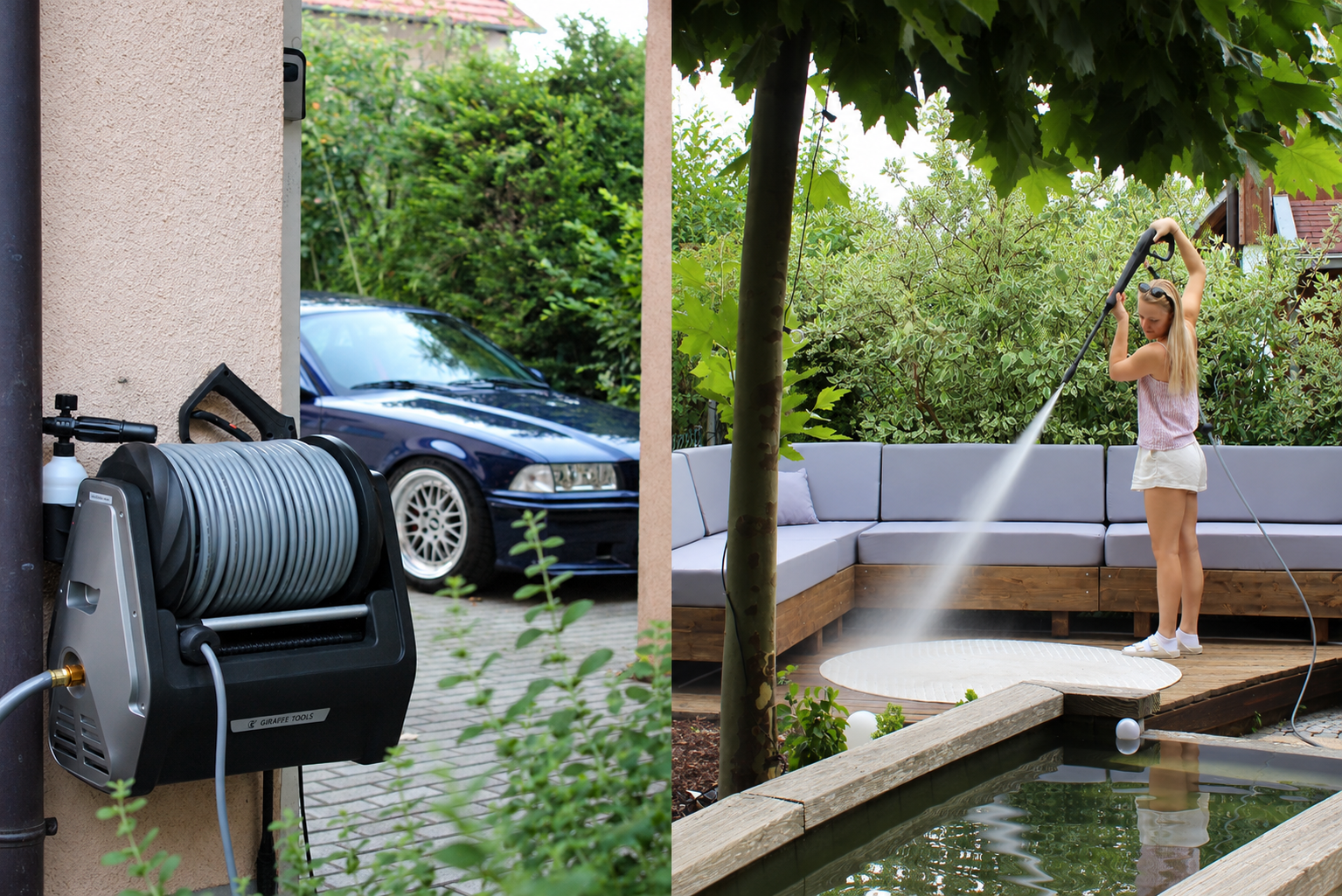






Choosing the right pressure washer nozzle starts with the surface you want to clean. A spray pattern that removes dirt from sound paving may be too concentrated for car paint, wooden furniture or fragile joints.
Some pressure washers use separate, colour-coded tips. Others use an adjustable nozzle that changes the spray pattern without swapping attachments. The UK Grandfalls Plus configuration covered in this guide includes a 0–80° adjustable nozzle, so the practical question is how wide or narrow the spray should be for each task.
This guide explains the differences, provides a quick reference for common household jobs, and shows why spray angle, working distance and surface condition all matter.
What Does a Pressure Washer Nozzle Do?
A pressure washer nozzle shapes the water leaving the lance.
A narrow spray concentrates the stream over a smaller area. A wider fan distributes it across more of the surface, making it useful for rinsing and covering larger sections.

However, a wide spray does not automatically make a surface safe to pressure wash. Moving too close, holding the spray still or cleaning damaged material can still cause problems.
Start with a broad fan, test an inconspicuous area and use the least aggressive approach that removes the dirt. Check the care instructions for both your pressure washer and the surface before you begin.
Adjustable Nozzles vs Fixed-Angle Tips
Fixed-angle pressure washer nozzles provide individual spray patterns. Common colour-coded sets include red 0°, yellow 15°, green 25° and white 40° tips. Some systems also include a separate detergent tip.
An adjustable nozzle combines a range of spray widths in one attachment. Instead of changing tips, you adjust the nozzle according to its instructions.
| Nozzle type | How it works | What to check |
|---|---|---|
| Fixed-angle tip | Each tip produces a specified spray angle | Select the correct tip and confirm compatibility |
| Adjustable nozzle | Changes between narrower and wider spray patterns | Check the adjustment method and observe the resulting fan |
| Turbo or rotary nozzle | Produces a rotating, concentrated jet | Confirm that the surface and machine support its use |
| Foam attachment | Applies a suitable detergent solution | Follow the attachment and detergent instructions |
An adjustable nozzle is not the same as a turbo nozzle. Turning a nozzle to select its spray width does not mean the water jet rotates during cleaning.
Understanding the UK Grandfalls Plus 0–80° Nozzle
The supplied adjustable nozzle is specified for a 0–80° spray range, from a concentrated jet to a broad fan.
Treat that range as a description of the available spray patterns. Unless the nozzle has clearly marked, documented positions, do not assume you can select an exact 15°, 25° or 40° setting.
The following specifications apply to the UK Grandfalls Retractable Pressure Washer Plus:
| Specification | Published figure |
|---|---|
| Maximum pressure at initial discharge | 165 bar |
| Rated pressure under typical load | 125 bar |
| Maximum flow with nozzle open | 8.0 L/min |
| Rated flow under typical load | 5.0 L/min |
| Pressure hose | 30m replaceable grey Ultra-Soft hose |
| Motor | 2kW brush motor |
| Intended use | Residential cleaning |
The maximum and rated figures describe different operating conditions. They are not interchangeable, and they are not selectable nozzle settings.
Pressure Washer Nozzle Guide by Cleaning Task
Use this chart to plan your approach. It does not replace the surface manufacturer’s instructions or guarantee that a particular material can be pressure washed.

| Cleaning task | What to check first | Spray-pattern approach | Avoid |
|---|---|---|---|
| Car bodywork | Paint condition and vehicle care instructions | Begin with a broad fan and generous working distance | Pinpoint jets, close spraying and damaged paint |
| Sound patio paving | Paving material and joint condition | Test a broad fan before considering a more concentrated pattern | Directing a concentrated jet into joints |
| Block-paved driveway | Loose blocks, jointing sand and surface coatings | Use controlled, moving passes where pressure washing is permitted | Washing out jointing sand |
| Garden furniture | Material, finish and care label | Use a broad fan only where the manufacturer permits pressure washing | Loose paint, fragile weave and close spraying |
| Wooden decking or furniture | Timber condition and care instructions | Prefer a gentler method unless pressure washing is explicitly supported | Concentrated jets that can damage fibres |
| Detergent application | Detergent suitability and dilution | Use the supplied foam attachment as directed | Assuming the widest spray is a soap setting |
Choosing a Nozzle for Car Washing
For car paint, begin with a broad fan rather than a narrow or pinpoint stream. Rinse loose grit before contact washing, keep the spray moving and pay attention to chips, peeling paint, seals and trim.

Working distance matters as much as spray width. For example, Volvo’s UK guidance for the XC40 specifies sweeping movements and a minimum distance of 30cm, while warning against direct spraying into locks or the fuel-filler area. Follow the instructions for your own vehicle, which may require a different approach. Volvo UK: High-pressure washing
Do not narrow the spray simply because dirt remains. Suitable car shampoo and careful contact washing may be more appropriate than increasing the concentration of the jet.
For the complete washing sequence, see our guide to washing your car at home.
Choosing a Spray for Patios and Block Paving
Sweep away loose debris and inspect the paving before switching on the washer. Cracked surfaces, loose mortar and missing jointing material need attention before cleaning.
Start with a broad fan on a small test area. Only consider a more concentrated pattern if the paving manufacturer permits it and the test shows no surface or joint damage.
Marshalls recommends testing a small area, using no more than medium pressure, and holding the lance obliquely rather than directing it straight down. Its guidance also explains that jointing sand lost during washing should be replaced. “Medium pressure” is not a universal numerical setting for every machine.
For material-specific cleaning considerations, read our guide to cleaning paving slabs and removing dirt, moss and algae.
Choosing a Spray for Garden Furniture
Check the furniture’s care label first. Plastic, coated metal, timber and woven furniture can require different cleaning methods.
Where pressure washing is permitted, test a broad fan from farther away before cleaning the whole item. Stop if you notice lifting paint, roughening timber or movement in the weave.
For delicate or weathered furniture, a soft brush, suitable cleaner and gentle rinse may be the better option.
How Spray Angle, Pressure and Distance Work Together
Three factors affect the cleaning result:
- Spray angle changes the concentration and coverage of the jet.
- Working pressure and flow describe the machine’s operating performance.
- Distance changes how the jet reaches the surface.
There is no reliable universal chart that converts each nozzle angle into a specific bar or PSI reading. A 40° spray does not automatically mean a particular pressure, and selecting a wider fan does not prove that pump pressure has dropped to a known value.
For the Grandfalls Plus, 165 bar is the maximum pressure at initial discharge; 125 bar is the rated pressure under typical load. Neither figure should be treated as a recommended pressure for every surface.
Applying Detergent with the Foam Attachment
The UK Plus package includes a separate foam attachment. Use this for detergent application according to the product manual.
Choose a detergent suitable for both the equipment and the surface, and follow its dilution and dwell-time instructions. Do not allow detergent to dry on the surface.
An 80° spray is not automatically a detergent mode. Spray width alone does not tell you how a machine draws or mixes cleaning solution.
Before removing or changing an attachment, switch off the machine and release stored pressure as directed by the manual.
Checking Replacement Nozzle Compatibility
Do not buy a replacement pressure washer nozzle by appearance or connector shape alone.
Confirm:
- Compatibility with your exact machine and spray gun.
- Connector type and size.
- Suitable pressure and flow ratings.
- The intended cleaning application.
The nozzle must suit the complete system. If compatibility is unclear, check with Giraffe Tools before fitting a third-party attachment.
FAQs
What pressure washer nozzle should I use for a car?
Begin with a broad fan and follow the vehicle manufacturer’s guidance on distance and technique. Avoid pinpoint jets and direct spraying into vulnerable openings. A wider spray does not eliminate the risk of damage.
Can I use the 0° setting for everyday cleaning?
A pinpoint jet concentrates the stream into a very small area and is unsuitable as a default for household cleaning. Use a broader pattern unless the equipment and surface manufacturers explicitly support a specific application.
Do I need coloured tips for the UK Grandfalls Plus?
The configuration described here includes a 0–80° adjustable nozzle. It does not require swapping between coloured fixed-angle tips to change the supplied nozzle’s spray width.
Is the widest setting always the best?
A wide fan is a sensible starting point for testing, but it may not remove every type of dirt. Consider the surface, cleaner and technique before making the spray more concentrated.
Is an adjustable nozzle a universal replacement?
No. Adjustable nozzles differ in their connectors, operating specifications and compatibility. Check the exact product requirements before purchasing.